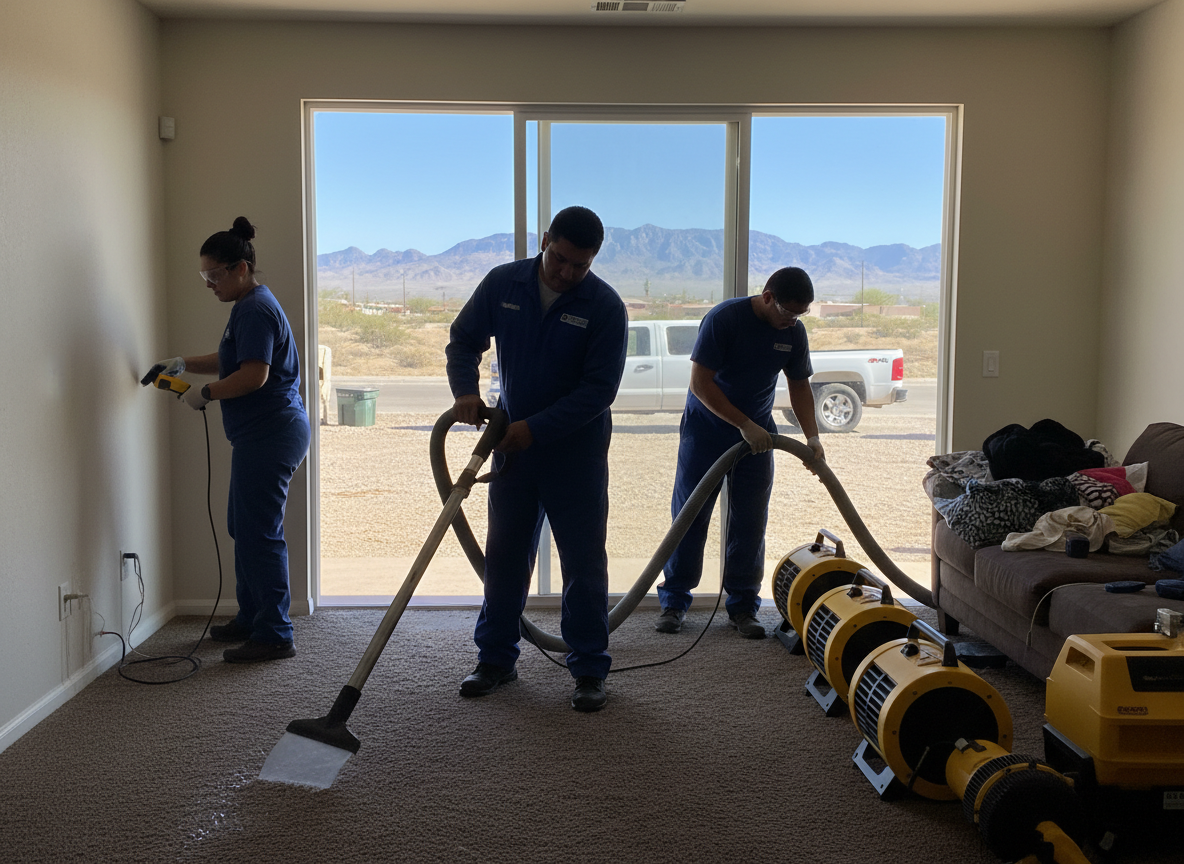
Fort Bliss properties face water damage from aging base plumbing, monsoon runoff along the eastern slopes, and occasional pipe failures in family housing units built from the 1950s onward. Our crews coordinate gate access at Pershing and Cassidy to reach affected homes and barracks quickly, extracting standing water and drying wall cavities before mold sets in on the gypsum board common in these structures.
We focus on the concrete slab foundations and flat-roof barracks typical inside the main post. Water migrating under slabs or through roof penetrations at Biggs Army Airfield housing requires targeted moisture mapping and targeted drying that accounts for the compacted caliche soils and limited yard drainage around the blocks near Robert E. Lee Gate.
Service calls to Fort Bliss also cover the William Beaumont area where medical facility support buildings and nearby NCO housing share older galvanized lines prone to pinhole leaks. We stage equipment at the 8420 El Camino Real location and roll with the necessary base credentials to complete extraction and drying on the same day whenever possible.
Around 11. Fort Bliss
We regularly work near:
- 📍Pershing Gate
- 📍William Beaumont Army Medical Center
- 📍Biggs Army Airfield housing
- 📍Robert E. Lee Gate
- 📍Castner Range perimeter
Water Damage Restoration in 11. Fort Bliss — Local Notes
- •Mid-century family housing on the main post often has slab-on-grade construction with limited access points for under-slab drying.
- •Monsoon season runoff funnels along the eastern perimeter near Castner Range, pushing water into ground-level utility rooms.
- •Gate processing at Pershing Road and Cassidy Gate adds time; advance coordination keeps response under two hours from the Atascadero dispatch.
- •Barracks and medical support buildings around William Beaumont use older galvanized supply lines that corrode faster in the desert temperature swings.